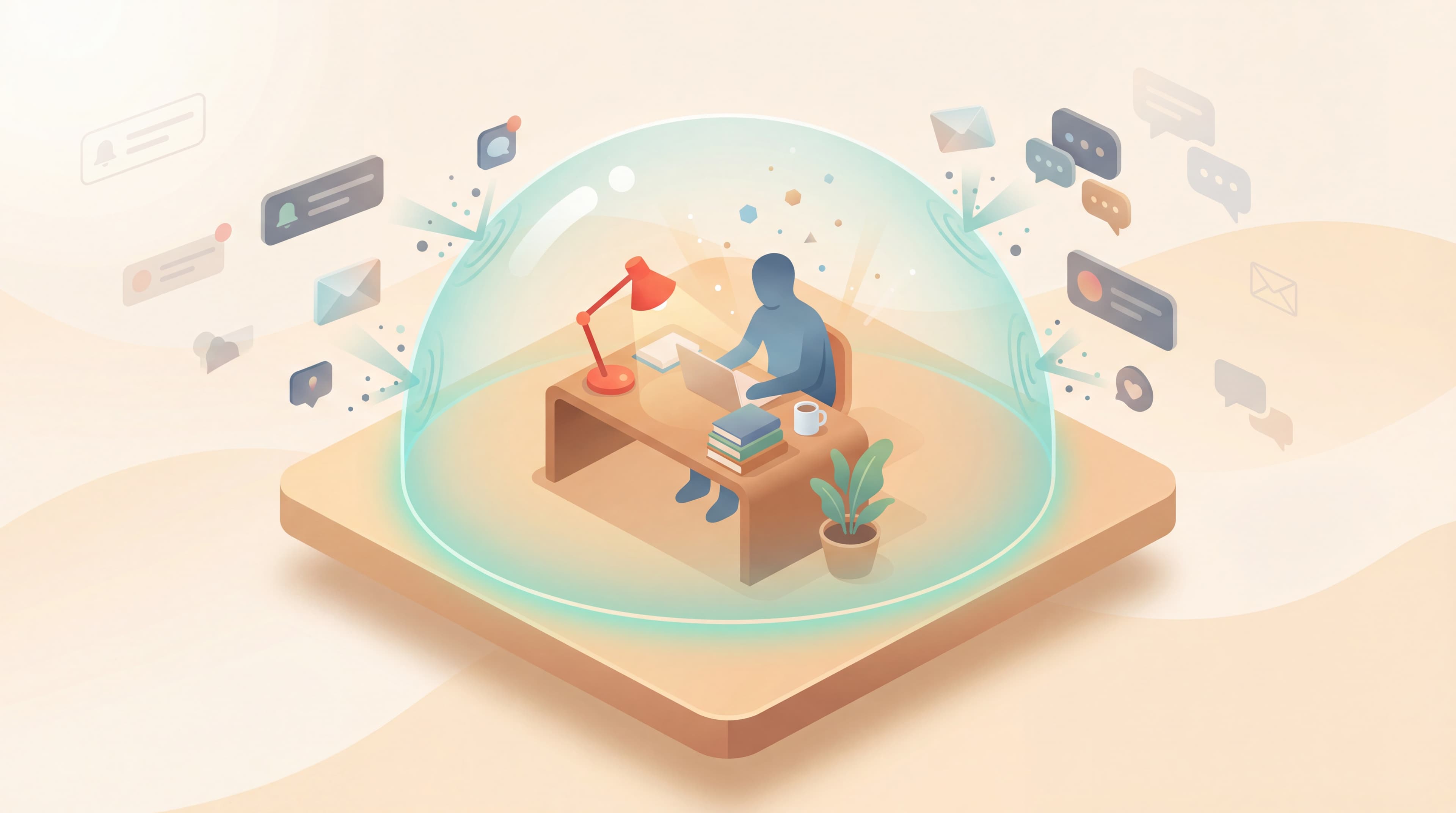
The average knowledge worker checks email every 6 minutes. Gets interrupted every 11 minutes. And spends only 2 hours and 48 minutes actually being productive each day.
That's not a productivity problem. That's a focus crisis.
In a world designed to distract you — notifications, open offices, endless meetings, social media — the ability to focus deeply has become the new superpower. Those who master it don't just get more done. They produce work that matters.
This is what Cal Newport calls Deep Work: the ability to focus without distraction on a cognitively demanding task.
In this guide, you'll learn exactly what deep work is, why it's becoming increasingly rare (and valuable), and how to build your own practice of distraction-free focus.
Deep work is professional work performed in a state of distraction-free concentration that pushes your cognitive capabilities to their limit.
Cal Newport, a computer science professor at Georgetown University and author of "Deep Work: Rules for Focused Success in a Distracted World," defines it as:
"Professional activities performed in a state of distraction-free concentration that push your cognitive capabilities to their limit. These efforts create new value, improve your skill, and are hard to replicate."
The opposite is shallow work: non-cognitively demanding, logistical-style tasks, often performed while distracted. These efforts don't create much new value and are easy to replicate.
- Writing a complex report or proposal
- Coding a new feature without interruptions
- Learning a new skill or language
- Strategic planning and problem-solving
- Creative work: designing, composing, inventing
- Deep reading and research
- Checking and responding to emails
- Attending status update meetings
- Filling out administrative forms
- Scrolling through social media
- Quick Slack messages and interruptions
- Organizing files and folders
The distinction matters because deep work is where real value is created. Yet most of us spend our days drowning in shallow work, wondering why we feel busy but unproductive.
Newport's central argument is powerful:
"The ability to perform deep work is becoming increasingly rare at exactly the same time it is becoming increasingly valuable in our economy. As a consequence, the few who cultivate this skill will thrive."
Here's why this matters:
In our hyperconnected age, most people are constantly distracted. They respond to every notification, attend every meeting, and fragment their attention across dozens of tasks daily.
This means deep work has become rare. But the economy still rewards people who can produce exceptional results — complex code, breakthrough ideas, compelling content, strategic insights.
Those who can focus deeply will produce more, create better work, and become irreplaceable. Those who can't will compete for increasingly commoditized shallow-work jobs.
Deep work isn't just a productivity hack. It's a career strategy.
Deep work isn't just philosophy. It's grounded in neuroscience.
Professor Sophie Leroy at the University of Washington discovered something critical: when you switch from Task A to Task B, your attention doesn't immediately follow.
Part of your mind keeps thinking about the previous task. This is called attention residue — and it significantly reduces your cognitive performance.
The more you switch between tasks, the more residue accumulates. By the end of a fragmented day, you're operating at a fraction of your potential.
Deep work solves this by dedicating extended, uninterrupted time to a single task. Your brain fully engages without the performance penalty of context switching.
Neurological research shows that focused practice triggers myelination — the process of wrapping neural circuits with a layer of fatty tissue that allows them to fire more efficiently.
In other words: focused, deliberate work literally makes your brain faster at that skill.
Distracted work doesn't trigger the same effect. You might spend hours on a task, but without deep focus, you're not building the neural pathways that lead to mastery.
This is why one hour of deep work can produce more results than four hours of distracted effort.
Deep work is closely related to what psychologist Mihaly Csikszentmihalyi calls flow — the mental state where you're fully immersed in an activity, time seems to disappear, and work feels effortless.
Research shows that people are happiest when they're in flow states. Deep work creates the conditions for flow: clear goals, immediate feedback, and a challenge-skill balance.
Deep work isn't just productive. It's deeply satisfying.
Newport outlines four rules for cultivating deep work. Let's explore each:
This sounds obvious, but the key insight is that deep work requires intentional rituals and routines. You can't just decide to "focus harder."
Strategies for working deeply:
Choose your depth philosophy:
- Monastic: Eliminate or radically minimize shallow obligations (like bestselling author Neal Stephenson, who has no email)
- Bimodal: Dedicate some clearly defined stretches to deep work (like Carl Jung retreating to his tower)
- Rhythmic: Create a daily habit of deep work at the same time each day
- Journalistic: Fit deep work wherever you can into your schedule (requires training)
For most people, the rhythmic philosophy works best. Same time, same place, every day.
Build rituals:
- Decide where you'll work and for how long
- Determine how you'll work (no internet? specific tools only?)
- Prepare what supports the work (coffee, music, closed door)
The goal is to make starting deep work automatic, removing the decision fatigue that leads to procrastination.
Here's an uncomfortable truth: if you can't tolerate boredom, you can't do deep work.
Most people, the moment they have a free second — waiting in line, riding an elevator, sitting at a red light — reach for their phone. This conditions your brain to expect constant stimulation.
When you then try to focus deeply, your brain rebels. It craves the quick dopamine hits it's become accustomed to.
The solution: practice being bored.
- Don't reach for your phone during idle moments
- Take walks without podcasts or music
- Wait in line without scrolling
- Build "productive meditation" into your day — focusing on a single problem while doing physical activity
This rewires your brain to tolerate the absence of novelty. Over time, deep focus becomes easier.
Newport is famously critical of social media, calling it the "smoking of the 21st century" for attention.
He doesn't argue that social media has no value. He argues that most people don't evaluate the trade-off between the minor benefits and the massive cost to their attention.
The approach: apply the Craftsman Approach to Tool Selection.
- Identify the core factors that determine success and happiness in your professional and personal life
- Adopt a tool only if its positive impacts substantially outweigh its negative impacts
- Don't adopt a tool just because it offers "any benefit"
Many people use Twitter because it offers "some networking value" or Instagram because it "helps stay connected." But the cost — fractured attention, reduced deep work capacity, hours lost scrolling — often vastly exceeds the benefit.
If you can't quit entirely, consider:
- Scheduled social media times (e.g., 30 minutes at lunch)
- Delete apps from your phone; access only via desktop
- Take extended breaks (30 days) to evaluate true value
You can't eliminate all shallow work. Emails must be answered. Meetings must sometimes happen. But you can ruthlessly minimize it.
Strategies:
Schedule every minute of your day:
Use time blocking. Every minute of your workday should be intentionally assigned to a task. This forces you to be realistic about how much shallow work creeps in — and protects your deep work time.
Quantify the depth of every activity:
Ask: "How long would it take (in months) to train a smart recent college graduate with no specialized training to complete this task?"
If the answer is "a few weeks," it's shallow work. If it's "years," it's deep work. Prioritize accordingly.
Finish your work by 5:30 PM:
Newport calls this "fixed-schedule productivity." By committing to end work at a specific time, you're forced to be ruthless about what deserves your attention.
Paradoxically, constraints increase productivity.
Become hard to reach:
- Check email at scheduled times (e.g., 11 AM and 4 PM)
- Use filters and automation
- Set expectations for response times
- Don't reply to emails that don't require a response
Theory is nice. Here's how to actually implement deep work starting this week:
For one week, track how you spend your time. You'll likely discover:
- How often you check email (probably every few minutes)
- How many times you get interrupted
- How little true deep work you currently do
This audit creates awareness and motivation to change.
Start with 60-90 minute blocks. Put them in your calendar like you would an important meeting — because they are.
Best practices:
- Morning is usually best (before shallow work accumulates)
- Same time each day (builds routine)
- Protect this time ruthlessly (no meetings, no "quick questions")
If 90 minutes feels too long, start with 25 minutes using the
Pomodoro Technique and gradually extend.
Deep work requires complete focus. Your brain can only sustain this if it also gets complete rest.
At the end of each workday, conduct a shutdown ritual:
- Check your task list and calendar for anything urgent
- Transfer any incomplete items to tomorrow
- Say a phrase like "Shutdown complete"
- Close work apps and stop thinking about work
This gives your brain permission to truly disconnect, which is essential for recovery and next-day performance.
What gets measured gets managed. Track your daily deep work hours.
Newport suggests aiming for 4 hours of deep work per day for knowledge workers. Most people are shocked to discover they currently do less than one hour.
Even adding 2 hours of daily deep work will dramatically increase your output and skill development.
Your environment significantly impacts your ability to focus:
- Dedicated deep work location: A specific desk, room, or even coffee shop that you associate only with focused work
- Minimal distractions: Clear desk, closed door (if possible), no visible phone
- Noise control: Noise-canceling headphones, white noise, or ambient music (without lyrics)
- Close all unnecessary tabs before starting
- Use website blockers (Freedom, Cold Turkey, SelfControl)
- Put phone in another room or use airplane mode
- Close email and Slack entirely during deep work sessions
- Use a timer to create urgency and structure
- Specific drink: A particular coffee or tea you have only during deep work
- Starting routine: A consistent set of actions that signal "deep work is beginning"
- End routine: A clear way to close the deep work session
These elements help your brain recognize when it's time to focus deeply.
- Block 3-4 hour morning windows for coding
- Use headphones as a "do not disturb" signal
- Batch all meetings into afternoon slots
- Establish async communication norms with team
- First hours of the day for writing (before consuming any content)
- Separate research time from writing time
- Use full-screen writing apps to eliminate distractions
- Set word count targets, not time targets
- Protect at least 2 hours daily for strategic thinking
- Batch meetings into specific days if possible
- Practice saying "no" or "not now" to requests
- Delegate shallow work aggressively
- Study in focused 50-minute sessions with 10-minute breaks
- Use the same location for studying (trains your brain)
- Turn off phone completely during study sessions
- Review material in deep work mode (active recall > passive reading)
Deep work is a skill. Like any skill, it takes time to develop. Don't expect 4-hour focus sessions on day one.
Start small. 30-60 minutes is excellent for beginners. Build gradually.
If your deep work sessions are "when I have time," you'll never have time. Schedule them. Defend them. No exceptions.
Checking email "for just a second" during deep work destroys your focus. The attention residue will plague you for 20+ minutes.
One task. No switching. Period.
Deep work is cognitively demanding. Without proper rest, your capacity degrades.
Sleep 7-8 hours. Take real breaks. Disconnect in the evenings. Recovery is part of the system.
Tell your team or family about your deep work practice. Set expectations. A quick conversation can prevent countless interruptions.
Deep work and the
Pomodoro Techniqueare natural complements.
The Pomodoro Technique provides structure:
- Clear time boundaries (25 or 50 minute sessions)
- Built-in breaks (preventing burnout)
- Measurable progress (count completed pomodoros)
Deep work provides philosophy:
- What to spend those sessions on (cognitively demanding work)
- Why focus matters (neurological and economic benefits)
- How to design your environment and habits
A practical combination:
- Identify your most important deep work task
- Set a timer for 50 minutes (extended Pomodoro)
- Work without any interruption
- Take a 10-minute break (no screens)
- Repeat for 3-4 cycles = 3-4 hours of deep work
This structured approach makes deep work achievable even if you've never focused for more than 20 minutes in your life.
You've learned what deep work is, why it matters, and how to implement it.
Now there's only one thing left: do it.
Here's your assignment:
- Choose one important task that requires your full cognitive ability
- Block 60 minutes in your calendar (tomorrow morning is ideal)
- Prepare your environment: close email, silence phone, clear desk
- Work without interruption for the full 60 minutes
- Notice how much you accomplish compared to fragmented work
That one session will show you what's possible.
In a world where everyone is distracted, the focused will win. Not because they work longer hours, but because they extract more value from each hour.
Deep work is the skill of the 21st century.
Start building it today.
Deep work is the ability to focus without distraction on cognitively demanding tasks. It's becoming increasingly rare — and increasingly valuable.
Key insights:
- Deep work produces results that shallow work never can
- Attention residue makes task-switching extremely costly
- Your brain adapts: what you practice (distraction or focus) becomes your default
- Work deeply: build rituals that make focus automatic
- Embrace boredom: train your brain to tolerate the absence of stimulation
- Minimize shallow work: ruthlessly protect your deep work time
- Use structure: techniques like Pomodoro create the framework for sustained focus
The people producing the most valuable work in the world aren't necessarily smarter or more talented. They've simply mastered the ability to focus deeply while everyone else is drowning in distraction.
You can join them.
→ Start Your First Deep Work Session with Tommodoro — Free